(pdf) What is the signature of wisdom? A purposeful arrangement of parts—for where parts are ordered to an end, intelligence is implicated.1
See: Cosmic Accident or Intelligent Design
If you don’t believe that intelligent design was involved in the origin of life, then you essentially believe that a few unintelligent forces of physics acting alone could, under the right conditions, cause life to arise from dead chemicals on barren planets and eventually produce human intelligence and civilization. Peter Urone, for example, claims in his 2001 textbook College Physics that “only four distinct forces account for all known phenomena.”
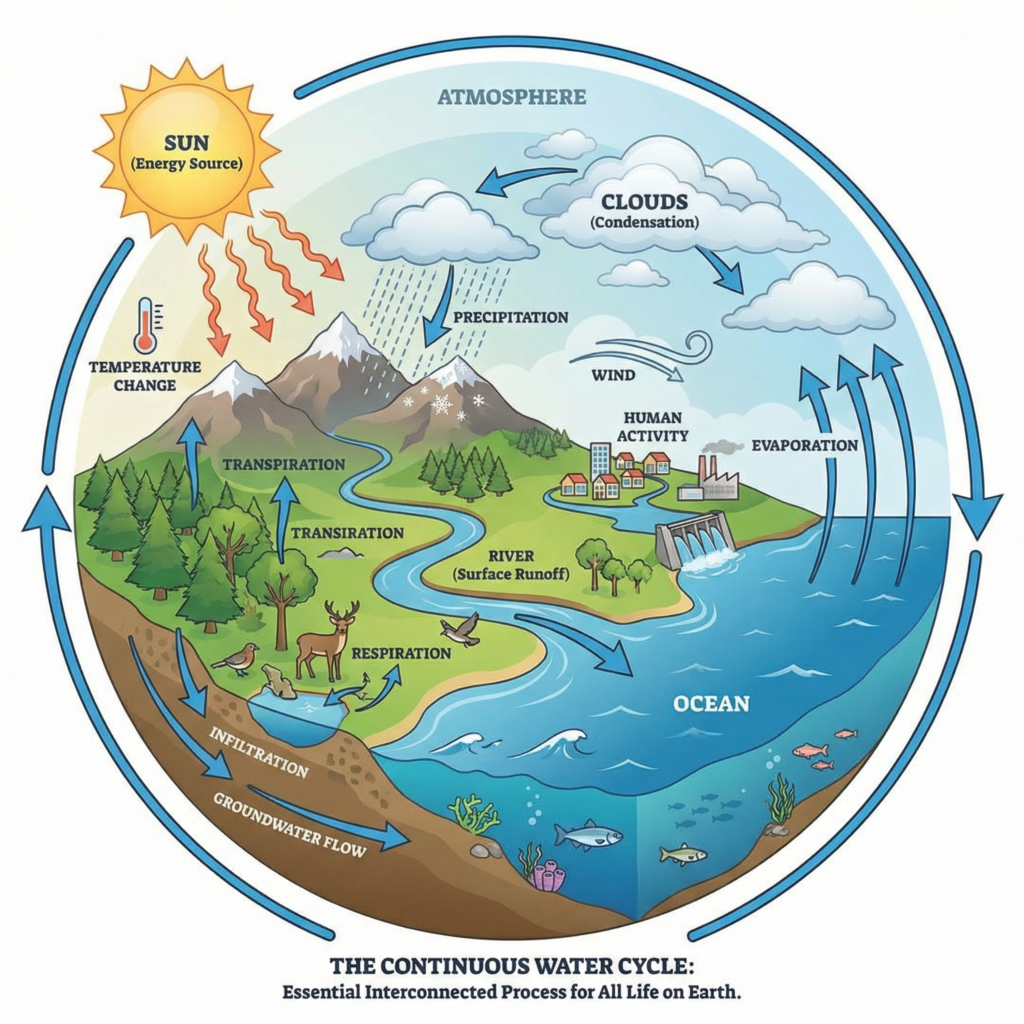
As it turns out, those four forces are very cleverly designed and fine-tuned for life. That itself requires an explanation.
The contrast is striking. The Moon and other planets are barren wastelands, hostile to life. By contrast, Earth is a habitat remarkably suited to carbon-based life. It possesses an extraordinary, interconnected system of oceans, atmosphere, sunlight, clouds, winds, rainfall, rivers, fertile land, and continuously recycled fresh water. The water cycle is only one component of a much larger system that provides a stable habitat for carbon-based intelligent life and, ultimately, human civilization. Water itself has a remarkable combination of properties suited to biological life, while Earth’s atmosphere, hydrosphere, and other physical conditions work together to sustain it. How did this extraordinarily coordinated, life-sustaining system arise from those four forces?
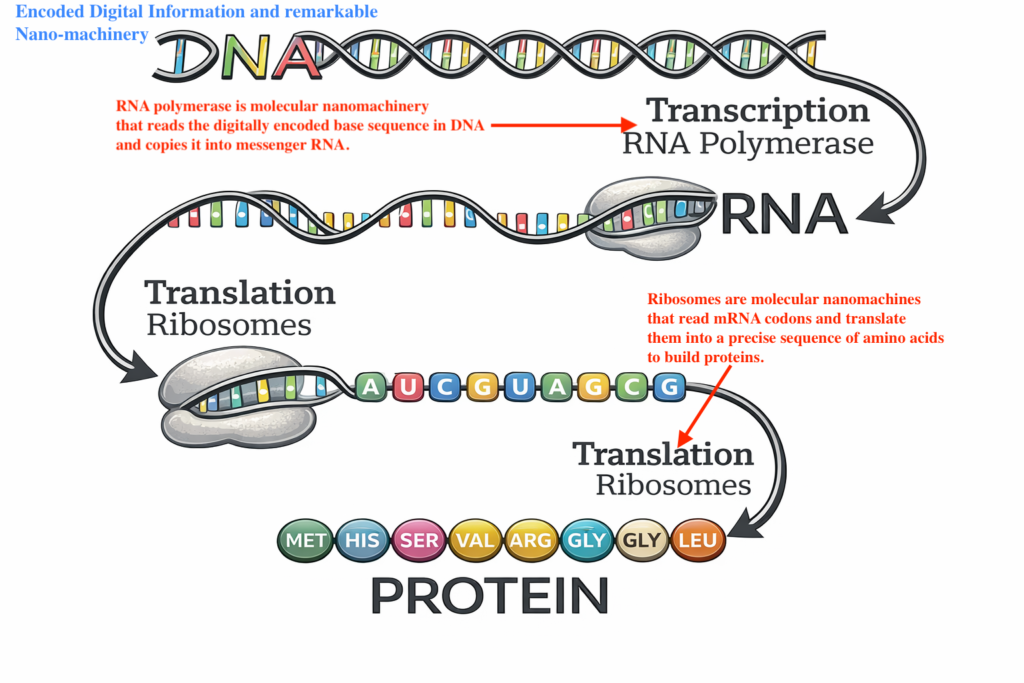
However, although those four forces (such as gravity and electromagnetism) are necessary for life, they are not on their own sufficient to explain the origin of the coded information needed for the nano-machinery and organized complexity of cellular life. And they are certainly not clever enough, by themselves, to explain how human intelligence and civilization arose on Earth.
Four Questions for Materialists
Here are the major questions materialists must answer to explain how human intelligence and civilization could have arisen on Earth by undirected forces that did not have us in mind.
- (Origin of life) How did first life arise from dead chemicals?How does all that nano-machinery and coded information in the cell arise from molecules that do not care about life?
- (Reproduction) How are these living things able to self-replicate, passing their current complex structures on to their descendants, generation after generation, without significant degradation?
- (Evolution) How did the accumulation of replication errors (random mutations) over millions of years result in the organized complexity of plants and animals?
- (Evolution of intelligent humans) How did this process of evolution eventually produce intelligent, conscious, humans, who are able to design computers and spaceships and smart phones?
Minds and Purpose
Minds (and only minds) can have purposes. Thus, to the extent it can manipulate things, a mind can arrange parts to achieve its purposes. Of course, we ourselves have minds. And it is a fundamental power of mind that it can discern purposes. Thus we can recognize that a mind has acted by perceiving a purposeful arrangement of parts. How else would we recognize another mind.
For the purpose of detecting other minds, “parts” can be virtually anything. Examples include: the purposeful arrangement of sounds in speech; words and letters in writing; mechanical parts in machinery. Likewise, the purpose of the heart is to pump blood, the eyes to see and wings for flight (read any textbook on anatomy and physiology).
Other phrases that people use to indicate intelligent design all boil down to purposeful arrangements of parts. For example, Stephen Meyer likes to point out that we know intelligent agents produce information, so when we come across coded information in a computer program we can conclude it was produced by an intelligent agent. Likewise for the coded information in the simplest cell. True enough. Yet how do we know there is information in a string of zeroes and ones — in a computer program? Only if we find that they are arranged for a purpose; that is, if the computer program has a function, if it can do something purposeful.
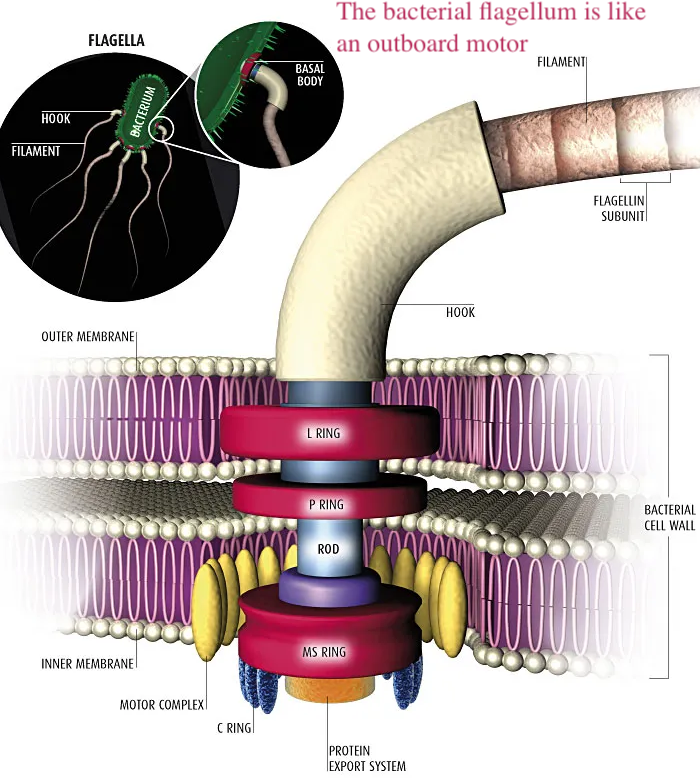
In the same way, Michael Behe (Darwin’s black box) describes how irreducibly complex systems such as the bacterial flagellum resist Darwinian explanation. But how do we know they are designed? Because we see they can do something, that they have a purpose, they are a purposeful arrangement of parts. Irreducibly complex systems have two relevant properties — their discontinuous nature resists Darwinism and their manifest purposiveness strongly points to design.
The eye demonstrates “specified complexity.” The “specified” in the phrase specified complexity is pretty much the same as “purposeful,” and “complexity” the same as “arrangement.” So the eye is a “purposeful arrangement” of parts.

Above, Plan and Purpose: an Eastern Bluebird in flight. Its wings are a highly integrated aerodynamic system of bones, joints, muscles, and feathers. Its eyes allow it to hunt visually from perches and detect tiny prey on the ground from 60 feet or more away, then calculate and execute the flight needed to intercept it. Its tiny brain must continuously integrate vision, balance, wing position, airspeed, obstacle avoidance, and landing control. In migratory populations, its brain supports seasonal orientation and navigation over very large distances. Northern Bluebirds do not simply wander south; their seasonal movements between breeding and wintering grounds require precise orientation, timing, and migration over distances of 2,000 miles.
Origin of Life
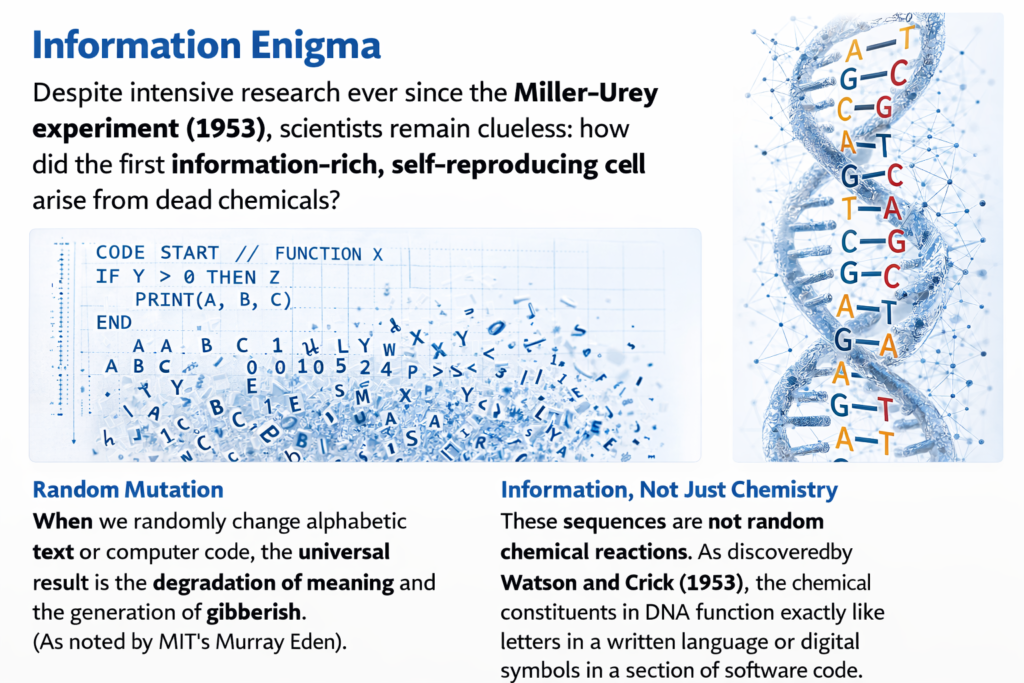
At Harvard in 2023, Rice University chemist James Tour challenged researchers in origin-of-life chemistry to explain, at the level of actual chemistry, how unguided prebiotic processes could produce the components and organization required for the first living cell. Tour had invited ten leading origin-of-life researchers to engage his objections.
Lee Cronin, professor of chemistry at the University of Glasgow, was the only one who accepted the invitation to respond publicly. As Tour argued in their exchange, Cronin’s assembly theory failed to provide a demonstrated chemical pathway from non-living matter to the first living cell. In Tour’s words, when it comes to explaining the origin of life, we remain “clueless.”
Inference to the Best Explanation
An abductive argument, i.e., inference to the best explanation:
| Premise 1 | Despite extensive investigation, no unguided materialistic processes have been discovered with the causal power to produce the purposeful arrangements of parts necessary to construct the first cell and subsequent biology.* |
| Premise 2 | By our common universal experience, intelligent agency alone is known to possess precisely this causal power to arrange parts purposefully to an end. |
| Conclusion | Intelligent design constitutes the only known causally adequate explanation for the origin of the purposeful arrangement of parts in the cell and subsequent biology. |
* Actually, chemists and biologists are clueless. See footnote for the problem of the combinatorial explosion of the search space.
Reality Check: the finger of God
There is enormous hype from the scientific establishment about the supposed creative power of chemical and biological evolution. Yet the history of molecular biology has made the problem harder, not easier. The first living cell once seemed comparatively simple. As our knowledge has increased, however, the minimum requirements for life have proved to involve astonishingly intricate systems of coded information, molecular machines, membranes, energy production, regulation, error correction, replication, and mutually dependent biochemical pathways. With every new layer of complexity discovered, the explanatory goalposts recede further and the combinatorial information problem becomes more formidable.
As science becomes more knowledgeable about how life works the problem of explaining how nonliving chemistry could have produced the first organized living system without plan or purpose becomes increasingly difficult. The goal post of understanding is receding!
If you want a reality check, consider the the third plague to remove the brutal slavery imposed by Egypt and its Pharaoh on the helpless Israelites (Ex. 8.12-15):
וַיֹּאמֶר ה׳ אֶל־מֹשֶׁה אֱמֹר אֶל־אַהֲרֹן נְטֵה אֶת־מַטְּךָ וְהַךְ אֶת־עֲפַר הָאָרֶץ וְהָיָה לְכִנִּם בְּכׇל־אֶרֶץ מִצְרָיִם׃
Then God said to Moses, “Say to Aaron: Stretch out your rod and strike the dust of the earth, and it shall turn to lice throughout the land of Egypt.” [Living lice from dead chemicals.]
וַיַּעֲשׂוּ־כֵן וַיֵּט אַהֲרֹן אֶת־יָדוֹ בְמַטֵּהוּ וַיַּךְ אֶת־עֲפַר הָאָרֶץ וַתְּהִי הַכִּנָּם בָּאָדָם וּבַבְּהֵמָה כׇּל־עֲפַר הָאָרֶץ הָיָה כִנִּים בְּכׇל־אֶרֶץ מִצְרָיִם׃
Aaron stretched out his arm with the rod and struck the dust of the earth, and lice came upon human and animal; all the dust of the earth turned to lice throughout the land of Egypt.
וַיַּעֲשׂוּ־כֵן הַחַרְטֻמִּים בְּלָטֵיהֶם לְהוֹצִיא אֶת־הַכִּנִּים וְלֹא יָכֹלוּ וַתְּהִי הַכִּנָּם בָּאָדָם וּבַבְּהֵמָה׃
The wizards did the same with their spells to produce lice, but they could not. The lice remained upon human and animal;
וַיֹּאמְרוּ הַחַרְטֻמִּם אֶל־פַּרְעֹה אֶצְבַּע אֱלֹקים הִוא וַיֶּחֱזַק לֵב־פַּרְעֹה וְלֹא־שָׁמַע אֲלֵהֶם כַּאֲשֶׁר דִּבֶּר ה׳׃
And the wizards said to Pharaoh, “This is the finger of God!” But Pharaoh’s heart hardened and he would not heed them, as God had spoken.
Now go the most advanced biochemical laboratory (2026). Provide the scientists with a single-celled bacterium (an organism vastly less complex than a louse). Once the bacterium is dead, all the chemicals are still in place. Ask the scientists to bring it back to life. The most advanced technology is not yet capable of recreating the organized complexity of life from dead chemicals.
If even intelligent agents armed with modern laboratories cannot yet accomplish this, then what grounds are there for hyped claims about the effortless creative power of unguided chemistry? The goalpost of finding detailed chemical or Darwinian pathways recedes ever further the more we know.
More than 3,300 years ago, the Egyptian science-magicians recognized the finger of the Creator and Guide of the universe (the one God, who abhors the injustice of Egypt and its Pharaoh). And so it is today. It is only the stubborn ideology of materialism—the ideology of the modern Pharaohs—that prevents recognition of a universe buzzing with Plan and Purpose.
Footnotes
Fig. 10.3, Stephen Meyer, Darwin’s Doubt, 2013. See also Signature in the Cell, 2009, and Cosmic Accident or Intelligent Design.
- Many proteins are needed for life. Douglas Axe provided experimental evidence for the the rarity of functional protein sequences by estimating how often random amino acid chains can form a working enzyme. For example, the protein beta-lactamose contains a sequence of 153 amino acids. For each functional sequence, 10^77 sequences are not functional. The overwhelming majority of possible sequence combinations are non-functional because they fail to meet the physical and chemical requirements of a working enzyme at three successive levels described in the experiment. So, the functional proteins are small islands in vast spaces of junk.
The rarity of functional configurations makes an appeal to a step-by-step Darwinian explanation of random mutation and natural selection highly improbable. A detailed Darwinian pathway for the beta-lactamase protein must identify a continuous pathway through viable intermediate states—where each intermediate provides a neutral (non-destructive) or functional advantage, despite the fact that the Darwinian mechanism has no foresight or goal at its disposal to guide it toward the highly coordinated final system. As the number and interdependence of the required components increase, the space of possible failures expands combinatorially, while the burden of specifying such a pathway becomes exponentially greater. Given that there are only an estimated 10^80 basic particles in the observable universe, the requirement of hundreds of distinct proteins for life presents an extraordinary probabilistic barrier so that the Darwinian blind search mechanism will inevitably fail due to the combinatorial explosion of the search space. ↩︎